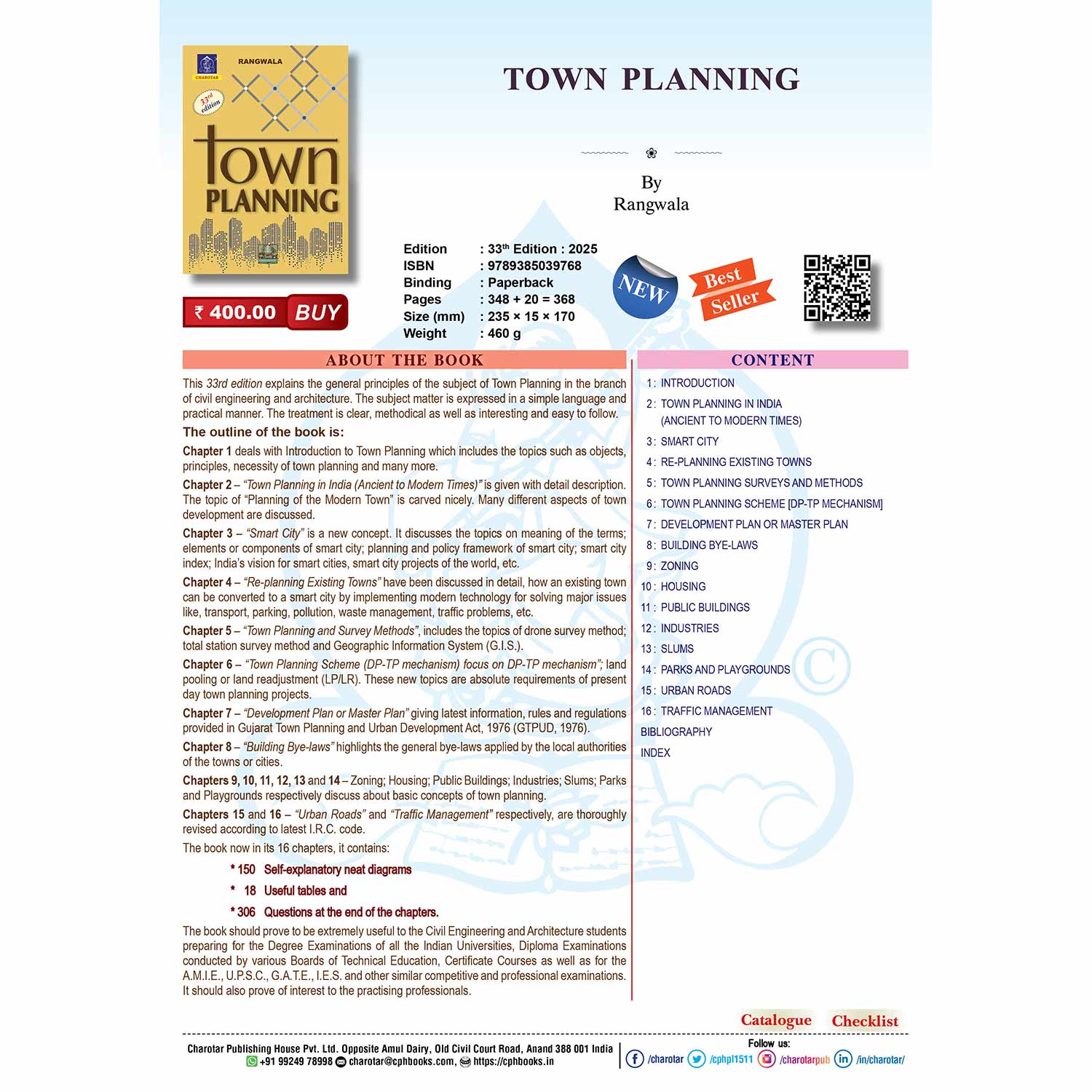
Content
1 : INTRODUCTION
2 : TOWN PLANNING IN INDIA
(ANCIENT TO MODERN TIMES)
3 : SMART CITY
4 : RE-PLANNING EXISTING TOWNS
5 : TOWN PLANNING SURVEYS AND METHODS
6 : TOWN PLANNING SCHEME [DP-TP MECHANISM]
7 : DEVELOPMENT PLAN OR MASTER PLAN
8 : BUILDING BYE-LAWS
9 : ZONING
10 : HOUSING
11 : PUBLIC BUILDINGS
12 : INDUSTRIES
13 : SLUMS
14 : PARKS AND PLAYGROUNDS
15 : URBAN ROADS
16 : TRAFFIC MANAGEMENT
BIBLIOGRAPHY
INDEX
Chapter 1 INTRODUCTION
1-1. General
1-2. Evolution of planning
1-3. Objects of town planning
(1) Object of beauty
(2) Object of convenience
(3) Object of environment
(4) Object of health
1-4. Economic justification for town planning
(1) Change in quantity of resources
(2) Demand for goods and services
(3) Production techniques
(4) Redistribution of land values
1-5. Principles of town planning
(1) Green belt
(2) Housing
(3) Public buildings
(4) Recreation centres
(5) Road systems
(6) Transport facilities
(7) Zoning
1-6. Necessity of town planning
1-7. Origin of towns
(1) Topographical features
(2) Functional aspects
1-8. Growth of towns
1-8-1. Growth of towns according to origin
(1) Natural growth
(2) Planned growth
1-8-2. Growth of towns according to direction
(1) Horizontal growth
(2) Vertical growth
1-9. Classification of stages in town development
(1) Sir Patrick Geddes’ classification
(2) Lewis Mumford’s classification
(3) Griffith Taylor’s classification
(4) Classification of Indian villages
(5) Classification of Indian cities on the basis of population
1-10. Personality of town
1-11. Distribution of land uses
(1) Town centre
(2) Industrial area
(3) Residential area
(4) Open space
(5) Town periphery
1-12. Forms of planning
(1) Local planning
(2) Country planning
(3) Regional planning
(4) National planning
(5) International planning
1-13. Site for an ideal town
1-14. Requirements of new towns
(1) Function of the town
(2) Welfare of the people
QUESTIONS 1
Chapter 2 TOWN PLANNING IN INDIA (ANCIENT TO MODERN TIMES)
2-1. Town planning in ancient India
2-2. Indus valley civilization (IVC)
2-3. Mohanjo-Daro
2-4. Lothal
2-5. Planning of the modern town
2-5-1. Airports
(1) Introduction
(2) Location of an airport
(3) Size of an airport
(4) Noise control at airports
(5) Parts and facilities required of an airport
2-5-2. City blocks
2-5-3. Conurbations
(1) Employment
(2) Living standard
(3) Public amenities
2-5-4. Green belt
2-5-5. Focal points
2-5-6. Neighbourhood planning
(1) General
(2) Principles of planning
(3) Importance
(4) Features of neighbourhood unit
2-5-7. Public utility services
2-5-8. Radburn layout
2-5-9. Cul-de-sac streets
2-5-10. Protective strips
2-5-11. Rapid transit system
(1) Maintenance of roads
(2) Reduction in traffic congestion
(3) Reduction of running time
2-6. Planning of cantonment or military station
(1) Density of development
(2) Employment
(3) Function
(4) Housing
(5) Social grouping
(6) Status of individual
(7) Work places
2-7. Present position of planning in India
2-8. Planned cities of India
(1) Chandighar
(2) Gandhinagar
(3) Gujarat International Finance Tec–City (GIFT city) — A global finance hub
(4) Dholera Special Investment Region (DSIR)
QUESTIONS 2
Chapter 3 SMART CITY
3-1. Meaning of the term
(1) Greenfield site
(2) Brownfield site
3-2. Elements or components of smart city
3-3. Characteristics of smart city
3-4. Smart city planning
(1) Use of latest information technologies to achieve goals
(2) Forms of intelligence in smart city
3-5. Policy framework for smart city
(1) Control of population density
(2) Maintaining equitable lifestyle
(3) Right of future city dwellers
(4) Right of city itself
3-6. Smart city index
3-7. Technological applications in smart city
(1) Online collaborative sensor data management platforms
(2) Electronic cards
3-8. Smart buildings
3-9. India’s vision for smart city
(1) Atal Mission for Rejuvenation and Urban Transformation (AMRUT)
(2) Heritage City Development and Augmentation Yojana (HRIDAY)
(3) Housing for all (Urban)
(4) Smart city mission
3-10. Smart cities of the world
(1) Singapore
(2) Zurich, Switzerland
(3) Oslo, Norway
3-11. Smart city projects in Abu Dhabi
(1) Masdar city
(2) Zayed Smart City Project
3-12. Smart city projects in Dubai
(1) The sustainable city
(2) Dubai silicon oasis
(3) Dubai south district
(4) Desert rose city
(5) Sharjah sustainable city
QUESTIONS 3
Chapter 4 RE-PLANNING EXISTING TOWNS
4-1. General
4-2. Objects of re-planning
4-3. Defects of existing towns
4-4. Data to be collected
4-5. Urban renewal projects
(1) Conservation
(2) Co-operation
(3) Development plan
(4) Finance
(5) Legislation
(6) Period of project
(7) Redevelopment
(8) Rehabilitation
4-6. Redesigning existing towns with smart technologies
(1) Civil structures and structural surveillance application
(2) Food and water quality monitoring
(3) Smart power grids
(4) Transportation and traffic management
(5) Healthcare applications
4-7. Decentralization and recentralization
4-8. Garden city
4-9. Surface drains
(1) General
(2) Requirements of the surface drains
(3) Shapes of surface drains
4-10. Refuse of town
(1) Garbage
(2) Sewage
(3) Storm water
(4) Subsoil water
(5) Sullage
4-11. Smart waste management
(1) General
(2) Efficient and proper waste management
(3) Efficient solutions for smart city waste management
(4) Most common environmental problem
4-12. Recycling and zero waste
(1) Recycling
(2) Zero Waste
QUESTIONS 4
Chapter 5 TOWN PLANNING SURVEYS AND METHODS
5-1. General
5-2. Necessity of survey
5-3. Collection of data
(1) Functional survey
(2) Social survey
(3) Territorial survey
(4) Vital survey
5-4. Types of surveys
(1) Preliminary survey
(2) National survey
(3) Regional survey
(4) Civic survey
5-5. Uses of surveys
5-6. Methods to collect data for survey
(1) Collect the data through questionnaire form
(2) Collect the data through interviews
(3) Collect the data through specialists
(4) Collect the data through various records
(5) Collect the data through town planner
(6) Collect data through traditional methods
(7) Total station survey method
(8) Drone survey method
5-7. Survey drawings
5-8. Survey report
5-9. Geographic information system (G.I.S.) in town planning
(1) General
(2) Advantages of G.I.S. in town planning
(3) G.I.S. tools or G.I.S. functions
(4) Practical applications of G.I.S. in town planning
QUESTIONS 5
Chapter 6 TOWN PLANNING SCHEME [DP-TP MECHANISM]
6-1. General
6-2. Glossary of terms and definitions
(1) Land pooling / Land readjustment
(2) Development plan (DP) or master plan
(3) Town planning scheme
(4) Draft town planning scheme
(5) Preliminary town planning scheme
(6) Final town planning scheme
(7) Melavani
(8) Gujarat Town Planning and Urban Development Act (GTPUDA) 1976
(9) Land value capture
6-3. Purpose and vision for T. P. Schemes
(1) Area specific needs
(2) Development potential
(3) Planning context
(4) Topography and natural features
(5) Urban environment
6-4. Principles for T.P. Schemes
6-5. Powers required to enforce T.P. Schemes
6-6. Micro level planning for T.P. Scheme in India
(1) Laissez-faire development
(2) Development plan plus laissez-faire development
(3) Land acquisition plus development
(4) Private townships or colonizer license system
(5) The development plan-town planning (DP-TP) mechanism
6-7. Stages of T.P. Schemes
6-7-1. First stage
6-7-2. Second stage
6-7-3. Third stage
6-8. Statistics of T.P. Schemes in Gujarat
6-9. Cost, valuation and finance of T.P. Schemes
(1) Cost
(2) Valuation and finance
(3) Summary of valuation
(4) Revenue generation in T.P. Scheme
(5) Finance management
6-10. Land pooling (LP) or land readjustment (LR)
(1) Delhi land pooling policy
(2) Magarpatta land pooling model
(3) Land Pooling in Australia
(4) Land Pooling in Germany
(5) Land Pooling (LP) or land readjustment (LR) in Japan
6-11. Benefits of T.P. Scheme mechanism
6-12. Salient features of T.P. Scheme
6-13. Hindrances in framing T.P. Scheme
6-14. Case studies of various T.P. Schemes
(1) Prahaladnagar Town Planning Scheme
(2) Amaravati Town Planning Scheme
(3) SP Ring Road, Ahmedabad Case
(4) Bhuj Town Planning Scheme
(5) Logistic Zone Town Planning Scheme (Nidhrad-Godhavi-Chekhla)
QUESTIONS 6
Chapter 7 DEVELOPMENT PLAN OR MASTER PLAN
7-1. General
7-2. Objects of preparing a development plan
7-3. Necessity or purposes of a development plan
7-4. Features of a development plan
7-5. Data to be collected for development plan
7-6. Drawings to be prepared
7-7. Planning standards
7-8. Components of a development plan
(1) Development plan reports
(2) Development plan maps
7-9. Development plan for military town
7-10. Development plan for hill station
7-11. Report with development plan
7-12. Process of preparing development plan as per GTPUDA
(1) Stage 1
(2) Stage 2
(3) Stage 3
7-13. Execution of development plan
7-14. Conclusion
QUESTIONS 7
Chapter 8 BUILDING BYE-LAWS
8-1. General
(1) Standard
(2) Norm
(3) Regulation
(4) Bye-law
(5) Law
8-2. Objects of bye-laws
8-3. Importance of bye-laws
(1) Consultation with superior authority
(2) Consultation with subordinate authority
(3) Consultation with interested groups
8-4. Function of local authority
(1) Building bye-laws
(2) Powers to architects
8-5. Responsibility of owner
(1) Surveyor
(2) Architect
(3) Engineer
(4) Structural designer
(5) Clerk of works
8-6. Applicability of bye-laws
(1) Additions and alterations to a building
(2) New construction
(3) Requirement of open space
8-7. Principles underlying building bye-laws
8-8. Set-back or building line
8-9. Light plane
8-10. Floor space index
8-11. Definitions of Some terms
(1) Auditorium
(2) Basement or cellar
(3) Building unit
(4) Commercial building
(5) Consolidated open plot (C.O.P)
(6) Domestic building
(7) Dwelling house
(8) Dwelling unit
(9) Height of building
(10) Gamtal
(11) Garage — private
(12) Garage — public
(13) Habitable room
(14) Height of a room
(15) Home occupation
(16) Hazardous material
(17) Hut
(18) Industrial building
(19) Lift
(20) Loft
(21) Low-rise and high-rise buildings
(22) Margin
(23) Mezzanine floor
(24) Neighbourhood centre and civic centre
(25) Natural hazard prone areas
(26) Occupancy or use
(27) Open space
(28) Owner
(29) Office building
(30) Ownership tenement flats
(31) Parapet
(32) Parking space
(33) Partition
(34) Permission
(35) Plinth
(36) Plinth area
(37) Pent house
(38) Porch or portico
(39) Public and semi-public building
(40) Public purpose
(41) Road or street
(42) Road-level or street-level or grade
(43) Road line or street line
(44) Road width
(45) Row houses
(46) Semi-detached building
(47) Service road
(48) Shopping centre
(49) Skip floor
(50) Smoke-stop door
(51) Stair cover
(52) Storey
(53) Tenement
(54) Tenement buildings and flats
(55) Theatre and cinema (56 Water-closet (W.C.) (57 Water course (58 Water course, major (59 Water tanks or Talav or pond or lake
(60) Warehouse or godown
(61) Window
(62) Width of street
QUESTIONS 8
Chapter 9 ZONING
9-1. Meaning of the term
9-2. History of zoning
9-3. Uses of land
(1) Profit-making uses of land
(2) Non-profit-making uses of land
9-4. Objects of zoning
9-5. Land use planning
(1) Area allocation
(2) Central Business District (CBD)
(3) Demography
(4) Land market
(5) Location
(6) Natural elements or resources
(7) Topography
9-6. Principles of zoning
(1) Arrangement of zones
(2) Boundaries
(3) Existing towns
(4) Flexibility
(5) New towns
9-7. Advantages of zoning
(1) Danger from fire
(2) Future development
(3) General amenities
(4) Health of community
(5) Population distribution
(6) Public utility services
9-8. Importance of zoning
9-9. Aspects of zoning
(1) Density zoning
(2) Height zoning
(3) Use zoning
9-10. Zonal plan for military towns
9-11. Transition zone
9-12. Economy of zoning
9-13. Zoning powers
9-14. Maps for zoning
QUESTIONS 9
Chapter 10 HOUSING
10-1. General
10-2. Importance of housing
10-3. Demand for houses
(1) Immobility
(2) Initial investment
(3) Other problems
10-4. Selection of building site
10-5. Requirements of residential buildings
(1) Height
(2) Location
(3) Orientation
(4) Parks
(5) Privacy
(6) Security
(7) Space
(8) Utility services
(9) Ventilation
10-6. Classification of residential buildings
(1) Detached houses
(2) Semi-detached houses
(3) Row of houses
(4) Apartments or flats
(5) Skyscrapers
10-7. Trends in multi-storeyed buildings
10-8. High rise buildings (Skyscrapers) of India
(1) Lodha World View Project
(2) Oberoi Oasis towers or Three Sixty West
(3) DB Orchid Crown Towers or Rustamjee Crown Towers
(4) Shree Ram Palasis Royale
(5) Supernova Spira
(6) Lokhandwala Minerva
(7) One Avighna Park
(8) Trump Tower
(9) Lodha The Park
(10) The 42
(11) Nathani heights
(12) Omkar 1973
(13) Other towers
10-9. Design of residential areas
(1) Aesthetics
(2) Basic materials
(3) Housing unit
(4) Layout
(5) Size and shape
(6) Street system
10-10. Rural housing
(1) Accommodation
(2) Drainage
(3) Drinking water
(4) Housing activity
(5) Institutional activities
(6) Other amenities TYPICAL RURAL HOUSE
(1) Courtyard
(2) Rooms
(3) Verandah
10-11. Low Cost Housing
(1) Pressed soil block
(2) Techniques for cost reduction in low cost housing
10-12. Rural housing boards
(1) Economic development
(2) Improvement
(3) Self-help
10-13. Laurie Baker
10-14. Agencies for housing
(1) Government
(2) Co-operative housing societies
(3) Individuals
10-15. Investment in housing
10-16. GRUH Finance Corporation Ltd.
10-17. HUDCO
10-18. HDFC ltd.
10-19. LIC Housing Finance Limited
10-20. CIDCO
10-21. Mega projects of CIDCO
(1) Administrative city centre
(2) Amusement park
(3) City centre
(4) Commuter rail projects
(5) Golf course
(6) International convention centre
(7) International technology park
(8) Navi Mumbai Special Economic Zone (NMSEZ)
(9) Second international airport
(10) Major projects by CIDCO
10-22. Housing problem in India
10-23. National housing policy
(1) General
(2) Objectives of NHP
(3) Important features of NHP
(4) Criticism of NHP
(5) Conclusion
10-24. Pradhan Mantri Awas Yojna — Urban (PMAY-U) or EWS housing scheme
(1) Eligibility for EWS housing scheme
(2) Beneficiary of EWS housing scheme
(3) Benefits of EWS housing scheme
(4) Key parameters for EWS housing scheme
QUESTIONS 10
Chapter 11 PUBLIC BUILDINGS
11-1. General
11-2. Location of public buildings
(1) Foreground
(2) Grouping
(3) Monumental buildings
(4) Parking space
(5) Purpose
11-3. Classification of public buildings
(1) Dependent buildings
(2) Independent buildings
(3) Institutional buildings
(4) Miscellaneous buildings
11-4. Principles of design of public buildings
(1) Adequate sites
(2) Approaches
(3) Business buildings
(4) Comprehensive study
(5) Education
(6) Fire stations
(7) Hospitals
(8) Markets
(9) Refuse disposal
(10) Shops
(11) Social and cultural centres
11-5. Town centres
(1) Business centres
(2) Civic centres
(3) Light shopping centres
11-6. Grouping of public buildings
(1) Administrative buildings
(2) Educational buildings
(3) Health institutions
(4) Recreation institutions
(5) Social institutions
11-7. Civic aesthetics
(1) Constructive measures
(2) Destructive measures
(3) Preventive measures
QUESTIONS 11
Chapter 12 INDUSTRIES
12-1. General
12-2. Classification of industries
(1) Manufacturing industries
(2) Miscellaneous industries
(3) Special industries
12-3. Concentration of industries
(1) Reasons of concentration of industries
(2) Advantages of concentration of industries
(3) Disadvantages of concentration of industries
12-4. Requirements of an industry
12-5. Sitting of an industry
12-6. Measures to control location of industries
(1) By developing industrial townships
(2) By granting concessions
(3) By imposing restrictions
12-7. Industrial townships
(1) Layout
(2) Management
(3) Services and amenities
(4) Site
(5) Size
12-8. Treatment of industrial wastes
(1) General
(2) Characteristics of industrial wastes
(3) Treatment methods
QUESTIONS 12
Chapter 13 SLUMS
13-1. General
13-2. Causes of slums
(1) Decentralization
(2) Economic conditions
(3) Education
(4) Improper use of land
(5) Industrialization
(6) Lack of zoning
(7) Migrants
(8) Powers of local authority
(9) Repairs and maintenance
13-3. Characteristics of slums
(1) Appearance
(2) Fire hazards
(3) Health and sanitation
(4) Income criteria
(5) Morals
(6) Overcrowding
(7) Population
(8) Social isolation
(9) Way of life
13-4. Effects of slums
(1) Absence of amenities
(2) Health
(3) Surrounding locality
(4) Undesirable spots
(5) Working conditions
13-5. Slum clearance
(1) Objects
(2) Methods
13-6. Works of improvement
13-7. Open plot scheme
13-8. Slum clearance and rehousing
13-9. Prevention of slum formation
(1) Cheap housing
(2) Compulsion to employers
(3) Construction of buildings
(4) Maintenance and repairs
(5) Rent restrictions
(6) Social education
(7) Unauthorized construction
13-10. Resources for slum clearance programmes
13-11. The Indian slum
QUESTIONS 13
Chapter 14 PARKS AND PLAYGROUNDS
14-1. General
14-2. Types of recreation
(1) Passive type recreation or parks
(2) Active type recreation or playgrounds
14-3. Location of urban green spaces
(1) Distribution
(2) Location
(3) Planning
(4) Site selection
14-4. Classification of parks
(1) According to character
(2) According to purpose
(3) According to size
14-5. Theme parks of America
14-6. Park systems
(1) Belt or ring system
(2) Wedge or radial system
(3) Combination of belt and wedge systems
14-7. Park design
(1) Collection of data
(2) Commercial sports
(3) Division
(4) Facilities
(5) Marine parks
(6) Paths and walks
(7) Plantation
(8) Proportion of each type of recreation
(9) Views through trees
(10) Water
14-8. Finance for parks
(1) By donations
(2) By raising loan
(3) By spending from public fund
14-9. Parkways
14-10. Boulevards
14-11. Playgrounds
(1) Children upto the age of 6 years
(2) Children at school
(3) Youths and adults
(4) Private clubs
14-12. Space standards
14-13. Landscape architecture
(1) Continuous park system
(2) Selection of trees
(3) Size of trees
(4) Standard of living
(5) Street trees
QUESTIONS 14
Chapter 15 URBAN ROADS
15-1. General
15-2. Objects of urban roads
15-3. Requirements of a good city road
15-4. Factors to be considered
(1) Destination
(2) Importance of road
(3) Nature of traffic
(4) Use of road
15-5. Classification of urban roads
(1) Arterial roads
(2) Sub-arterial roads
(3) Local roads
(4) Streets
(5) Pathways
15-6. Types of roads
(1) Depending on use during different seasons
(2) Based on the type of the carriage way
(3) Based on the type of pavement surface
15-7. Types of Road systems
(1) Rectangular street system
(2) Rectangular with superimposed diagonals street system
(3) Concentric street system
(4) Radial street system
(5) Combination of radial and rectangular street system
(6) Irregular mediaeval street system
(7) Topographical street system
(8) Combination of rectangular and irregular street systems
15-8. Through and by-pass roads
15-9. Outer and inner ring roads
15-10. Expressways
15-11. Freeways
(1) Access from adjacent properties
(2) Design and construction
(3) Entrances and exits
(4) Intersections at grade
(5) Location
(6) Traffic control
15-12. Precincts
15-13. Road aesthetics
QUESTIONS 15
Chapter 16 TRAFFIC MANAGEMENT
16-1. General
16-2. Objects of traffic management
16-3. Road user characteristics
(1) Physical characteristics
(2) Mental characteristics
(3) Psychological characteristics
(4) Environmental characteristics
16-4. Vehicular characteristics
(1) Static characteristics of a vehicle
(2) Dynamic characteristics of a vehicle
16-5. Traffic surveys
16-5-1. Accident survey
16-5-2. Origin and destination (O & D) survey
(1) House interview method
(2) License plate method
(3) Postal questionnaire method
(4) Route interview method
(5) Tag-on-car method
16-5-3. Parking survey
(1) Parking accumulation
(2) Parking duration
(3) Parking load
(4) Parking turnover
(5) Parking volume
16-5-4. Spot speed survey
16-5-5. Speed and delay survey
16-5-6. Traffic volume survey
(1) Objects of traffic volume survey
(2) Methods of traffic volume survey
(3) Information collected in traffic volume survey
(4) Uses of traffic volume survey
16-6. Road accidents
16-6-1. Causes of road accidents
(1) Defective vehicles
(2) Drivers
(3) Moving of animals
(4) Passengers
(5) Pedestrians
(6) Road design
(7) Traffic volume
(8) Weather
16-6-2. Collection of accident data
(1) Engineering uses
(2) Enforcement uses
(3) Administrative and policy issues
(4) Educational uses
(5) Uses for motor vehicle administrator
16-6-3. Requirements of accident records
16-6-4. Collision diagram
16-6-5. Condition diagram
16-6-6. Measures to prevent road accidents
(1) Educational methods
(2) Enforcement methods
(3) Engineering methods
16-7. Parking
(1) Kerb or on-street parking
(2) Off-street parking
16-8. Methods of parking
16-9. Traffic congestion
(1) General public
(2) Road users
(3) Transport personnel
16-10. Traffic control
16-11. One-way streets
16-11-1. Advantages of one-way streets
(1) Improvement in pedestrian movements
(2) Improving safety
(3) Increasing average speed
(4) Increasing capacity
(5) Night traffic
(6) Reduction in accidents
(7) Traffic control
16-11-2. Disadvantages of one-way streets
(1) Effect on certain types of trade
(2) Operational difficulties
(3) Safety problems
16-12. Road junctions or intersections
(1) Angle of crossing
(2) Camber
(3) Channelizing
(4) Entry speeds
(5) Gradient
(6) Importance of roads
(7) Kerbs
(8) Pedestrian traffic
(9) Simplicity
(10) Visibility
16-13. Types of intersections
16-13-1. At-grade intersections
(1) All-paved or unchannelized intersections
(2) Channelized intersections
(3) Roundabouts or rotaries
16-13-2. Conflicts at an intersection
16-13-3. Grade separations or interchange
(1) Direct ramp
(2) Semi-direct ramp
(3) Indirect ramp
16-14. Traffic capacity of roads
16-15. Road traffic problems
16-16. Traffic control devices
16-16-1. Road markings
(1) Longitudinal markings
(2) Intersectional or transverse markings
(3) Hazardous location markings
(4) Parking markings
(5) Word messages
(6) Object markings
16-16-2. Road signs
(1) Purposes of road signs
(2) Limitations of road signs
(3) Design and location of road signs
(4) Types of road signs
16-16-3. Traffic signals
(1) Advantages of traffic signals
(2) Limitations of traffic signals
(3) Modern development
16-16-4. Speed breakers
16-17. Peculiarities of traffic
16-18. Traffic problems of existing towns
16-19. Street lighting in a town
(1) Purposes
(2) Efficient and proper street lighting
(3) Types of street lights
(4) Arrangements of street lights
(5) Lighting at intersections
(6) Lighting on curves
QUESTIONS 16
Bibliography
Index
Only logged in customers who have purchased this product may leave a review.

Reviews
There are no reviews yet.